
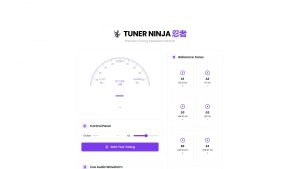
In the professional audio world, the quality of a performance is often decided long before the first note is played. Whether you are in a recording studio, a live concert venue, or a home practice space, the foundational accuracy of your instrument’s intonation is non-negotiable. Traditional hardware tuners have served musicians for decades, but the modern era demands higher flexibility, faster response times, and zero-latency feedback. This is precisely where the ninja tuner enters the workflow, providing a high-precision digital solution that operates entirely within your web browser.
What sets this particular tool apart is its sophisticated approach to frequency detection. Unlike basic tuners that may struggle with background noise or ambient interference, this engine utilizes advanced signal processing algorithms—specifically Fast Fourier Transform (FFT) analysis—to isolate the fundamental frequency of your instrument from unwanted overtones or environmental sound. For a guitarist or bassist working in a shared living space, this means the difference between a frustrating, inaccurate tuning session and a perfectly intonated instrument in mere seconds.
The technical elegance of the tool lies in its accessibility. Most professional-grade tuning software requires either a dedicated hardware pedal or a resource-heavy desktop application. By contrast, the web-based architecture of the Ninja Tuner ensures that you can achieve concert-level accuracy using nothing more than your laptop’s microphone or a standard audio interface. Because it leverages the power of the Web Audio API, the latency is practically non-existent, providing a “real-time” experience that feels as immediate as a physical needle moving on an analog display.
For music educators and session players, this tool is more than just a convenience; it is a pedagogical assistant. When teaching a student how to tune by ear, visual confirmation acts as an essential check-and-balance system. It allows the learner to visualize how subtle adjustments to the tuning peg change the frequency in real-time, effectively bridging the gap between mechanical action and auditory perception. This interactive nature accelerates the learning curve, helping students build the “muscle memory” of pitch recognition far faster than they would with traditional methods.
Furthermore, the tool is optimized for a variety of instruments. Whether you are tuning a standard 6-string guitar, a 5-string bass, or even orchestral strings like a cello or violin, the chromatic range of the system is designed to handle diverse frequency responses. By calibrating to standard A440 or experimenting with non-standard reference pitches, you retain full control over your tonal environment. This flexibility is critical for multi-instrumentalists who need to switch between different tunings without fiddling with complex gear setups.
Data privacy is also a significant concern for those who operate in professional environments. Because this engine performs all its audio processing locally within your browser’s cache, your audio data is never transmitted or stored on external servers. This provides a secure, private environment for your practice sessions, ensuring that your unique tone and creative ideas remain yours alone. As you integrate this tool into your daily routine, you will find that the consistency it brings to your performance becomes its most valuable feature.